
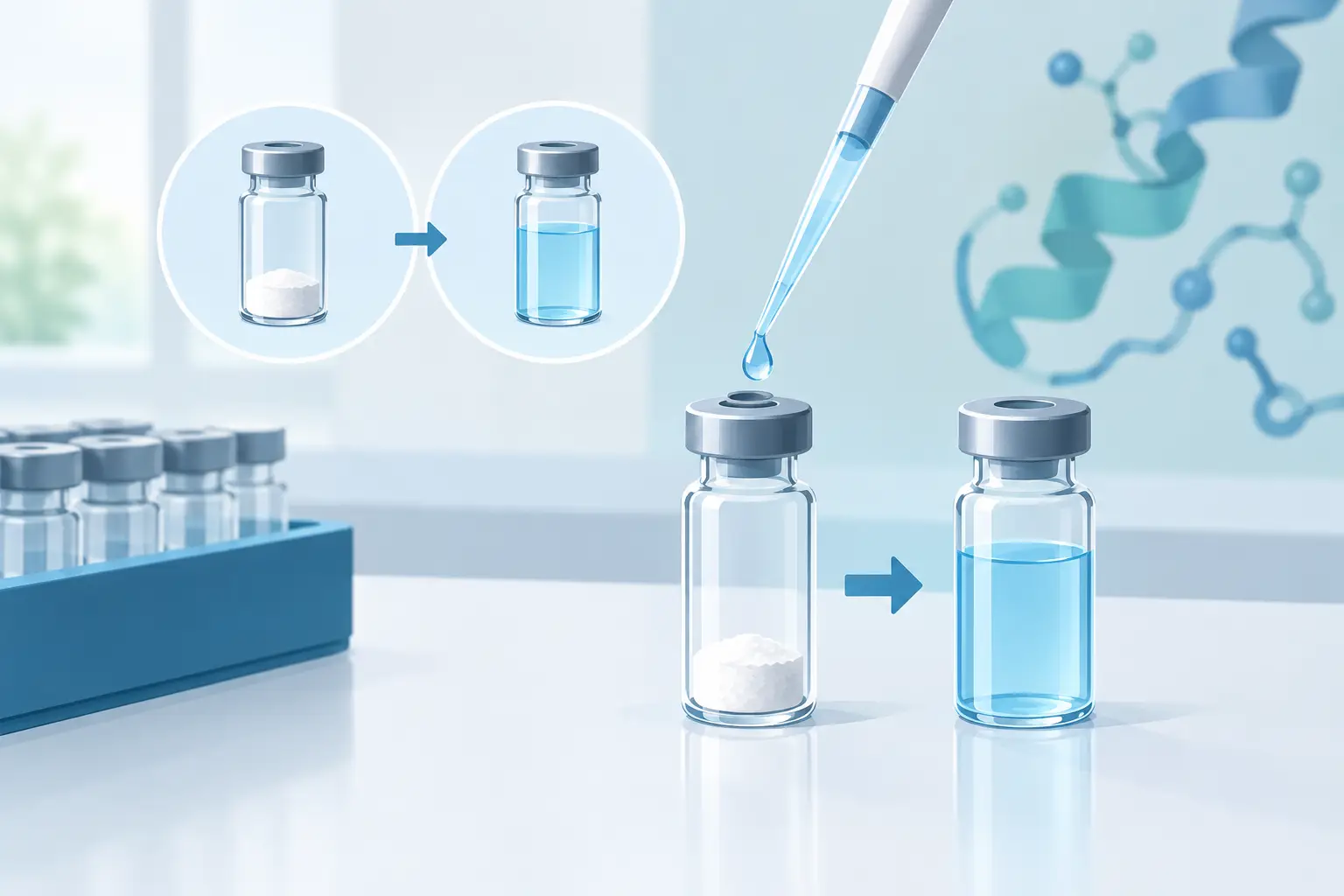
A peptide can arrive as a small, cleanly packaged lyophilized cake, but the reconstitution step determines whether that material enters a study as a controlled research reagent or a source of avoidable variability. Lyophilized peptide reconstitution for research is not a one-size-fits-all task. The right solvent, final concentration, handling conditions, and storage plan depend on the peptide’s chemistry and the assay ahead.
For qualified researchers, the goal is straightforward: protect material identity, preserve analytical integrity, and create a documented starting solution that performs as expected. Bring the heat to the research plan, not to the sample. Thoughtful preparation up front keeps the signal cleaner when it counts.
Start With the Peptide’s Research Documentation
Before opening a vial, review the product documentation, certificate of analysis, storage guidance, and any method references relevant to the specific peptide. Sequence, net charge, hydrophobicity, disulfide bonds, salt form, and intended experimental conditions can all influence solubility and stability.
Do not assume that a solvent suitable for one peptide will suit another. A highly water-soluble sequence may reconstitute readily in an appropriate aqueous vehicle, while a hydrophobic or aggregation-prone material may require a different validated approach. The experimental endpoint matters, too. A solvent that gets material into solution may still interfere with cell-based readouts, chromatography, spectroscopy, or another downstream method.
Confirm the vial label against the study record before preparation. Record the peptide name, lot number, stated quantity, date received, analyst, and intended stock concentration. That short checkpoint creates traceability before the first drop of solvent is added.
Lyophilized Peptide Reconstitution for Research: A Controlled Workflow
The best workflow is deliberate rather than complicated. Use clean, calibrated laboratory equipment and follow the facility’s approved procedures for PPE, contamination control, chemical handling, and waste. Work only with materials appropriate for the study and compatible with the peptide and assay.
Let the vial equilibrate before opening
If the material has been stored cold, allow the sealed vial to reach room temperature before opening it. This helps reduce moisture condensation on or in the vial. Lyophilized peptide material is often hygroscopic, meaning unnecessary exposure to ambient moisture can affect mass accuracy, handling behavior, and long-term stability.
Keep exposure brief. Open the vial only when supplies, labels, calculations, and solvent are ready. Avoid leaving the stopper or cap exposed while other steps are completed.
Choose a solvent based on compatibility, not habit
Aqueous laboratory-grade water may be suitable for some peptides, but it is not a universal answer. Buffered systems can help maintain pH where justified, while small proportions of compatible organic co-solvents may be considered for difficult-to-solubilize peptides when supported by the peptide’s properties and the study design.
Bacteriostatic water is often used as a supporting laboratory supply, but researchers should evaluate whether it is appropriate for their exact analytical or biological application. Preservatives, buffer components, ionic strength, and pH can all affect peptide behavior or assay performance. The solvent choice should be defended by a protocol, published method, preliminary compatibility data, or a combination of these.
When a co-solvent is needed, maintain control of the final solvent percentage across all test and vehicle-control conditions. A peptide result is difficult to interpret if the treatment group and control group are exposed to meaningfully different solvent environments.
Calculate the stock before dispensing
Set the target stock concentration based on the working range, expected dilution scheme, and practical pipetting limits. The basic relationship is simple:
Concentration = peptide mass / final solution volume
The calculation is only useful when the units are consistent. A common source of preventable error is mixing micrograms, milligrams, microliters, and milliliters without converting carefully. Verify the arithmetic independently, particularly when preparing concentrated stocks or multiple dilutions.
Build in room for realistic handling. A stock that is too dilute may require transfers near the lower limits of pipette accuracy. A stock that is too concentrated may risk incomplete dissolution, precipitation after dilution, or inappropriate solvent carryover in the assay. The best concentration is the one that is stable, measurable, and practical for the full protocol.
Add solvent gently and confirm dissolution
Add the calculated solvent volume carefully to the vial wall or bottom as appropriate for the container and protocol. Mix using a method suited to the peptide. Gentle inversion, low-intensity vortexing, or controlled pipette mixing may be appropriate depending on the material. Avoid treating aggressive mixing as the default, particularly for peptides or formulations known to aggregate or foam.
Visual inspection is useful but not definitive. A solution that looks clear may still contain aggregates, and a faint haze may signal incomplete dissolution or incompatibility. If the material does not dissolve as expected, do not force the issue with repeated agitation or unvalidated heating. Pause, review the peptide-specific guidance, and assess solvent, pH, concentration, temperature, and mixing method against the study plan.
Concentration Is Not the Same as Usable Material
A correctly calculated concentration does not automatically mean the peptide is fully available to the assay. Adsorption to plastic surfaces, precipitation during dilution, oxidation, hydrolysis, and aggregation can change the effective concentration over time.
This is where material selection and handling discipline earn their place. Use containers known to be compatible with the experiment, minimize unnecessary transfers, and consider low-binding consumables where adsorption is a documented concern. For assays where quantitative confidence is critical, researchers may need to verify concentration or identity using an analytical method appropriate to the lab’s capabilities and objectives.
The same principle applies to dilution. Prepare working solutions close to use when the method calls for it, and use a planned serial dilution strategy rather than improvising at the bench. Each step should preserve the control structure of the experiment and keep solvent composition consistent.
Storage Strategy: Protect the Stock, Protect the Study
Once reconstituted, a peptide solution is generally more vulnerable than the lyophilized starting material. The appropriate storage temperature and duration depend on the peptide, solvent, concentration, container, and study requirements. Follow product-specific guidance where available, then align it with the lab’s validated storage controls.
Aliquoting is often a sensible way to limit repeated freeze-thaw exposure. Prepare volumes that match realistic experimental use, label them clearly, and avoid creating a freezer full of poorly documented microtubes. Each aliquot should carry enough information to identify the peptide, stock concentration, solvent, preparation date, storage condition, and lot.
Track freeze-thaw events when relevant to the protocol. Repeated temperature cycling can affect some materials, but the actual impact depends on peptide chemistry and solution conditions. There is no substitute for stability information generated under conditions close to the intended use.
Build Documentation Into the Bench Routine
Strong peptide research does not rely on memory. A complete preparation record should capture the starting vial details, reagent lot numbers, solvent identity, calculations, final stock concentration, preparation date, storage location, and any observations during dissolution.
If a study later produces an unexpected result, this record helps distinguish a biological finding from a preparation issue. It also makes repeat work faster and more defensible. The researcher who can trace every stock back to its vial, solvent, and preparation method has a sharper foundation for interpreting data.
At Pepper Pep, the focus is research-grade material that supports qualified laboratory work with clear product handling and quality expectations. That support works best when the laboratory meets it with disciplined methods, clean records, and protocols designed for the actual research question.
Common Reconstitution Mistakes That Cost Time
The most expensive mistakes are usually small ones: selecting water because it is familiar rather than compatible, skipping the concentration check, using a stock beyond its supported stability window, or changing solvent conditions between treatment and control samples. These errors can create noise that looks like a result.
Another common problem is treating every peptide as interchangeable. Peptides vary widely in sequence-driven properties, and reconstitution must reflect that reality. A study plan should specify what to do when a solution appears incomplete, precipitates after dilution, or behaves differently than anticipated.
Keep the response evidence-based. Document the observation, retain the relevant lot and preparation details, and use approved analytical or troubleshooting procedures to determine whether the cause is solvent compatibility, concentration, storage history, container interaction, or another variable.
Keep Research Use Boundaries Clear
Research peptides and related laboratory supplies are intended solely for legitimate laboratory, analytical, and in vitro research by qualified professionals. They are not intended for human consumption, clinical use, diagnosis, treatment, or administration of any kind.
The best reconstitution protocol is not the fastest one. It is the one that gives your team a solution they can identify, reproduce, defend, and use with confidence when the research starts to heat up.
All products and information provided on this website are intended for laboratory research purposes only. Products are not intended for human consumption and are not intended to diagnose, treat, cure, or prevent any disease.