“Pharma grade” can sound like the final word in quality. For a qualified buyer, it should be the start of a verification process. Is pharma grade peptides legit? Sometimes the material and documentation support a serious quality claim. Other times, the phrase is doing more work than the supplier’s testing, lot records, or handling practices.
For research professionals, the question is not whether a label sounds premium. It is whether the product can stand up to scrutiny before it enters an in vitro, analytical, or scientific workflow. Bring the heat to your research standards, not to assumptions.
Is Pharma Grade Peptides Legit as a Quality Claim?
The short answer: the term is not automatically proof of legitimacy.
“Pharma grade” is often used to suggest that a peptide meets pharmaceutical manufacturing expectations. In a true pharmaceutical context, that claim carries substantial weight. It can involve validated manufacturing processes, formal quality systems, controlled facilities, detailed batch records, stability programs, release specifications, and regulatory obligations tied to an approved drug or investigational product.
That is very different from a research-use-only peptide sold for laboratory study. A research peptide may be high purity, independently tested, carefully packaged, and appropriate for qualified research applications without being an FDA-approved drug product or material manufactured under the same complete pharmaceutical framework.
The distinction matters because words such as “pharmaceutical,” “clinical,” “medical,” and “pharma grade” are sometimes used casually in online peptide marketing. A credible supplier should be able to explain what it means by its quality language and should not blur research-grade materials with products intended for human use.
For qualified researchers, a more useful question is: What evidence supports the identity, purity, quantity, and traceability of this specific lot?
What Legitimate Peptide Sourcing Looks Like
A legitimate source does not ask you to accept a broad promise at face value. It provides signals that can be checked, compared, and documented. The strongest signals are tied to the individual batch, not just the supplier’s homepage.
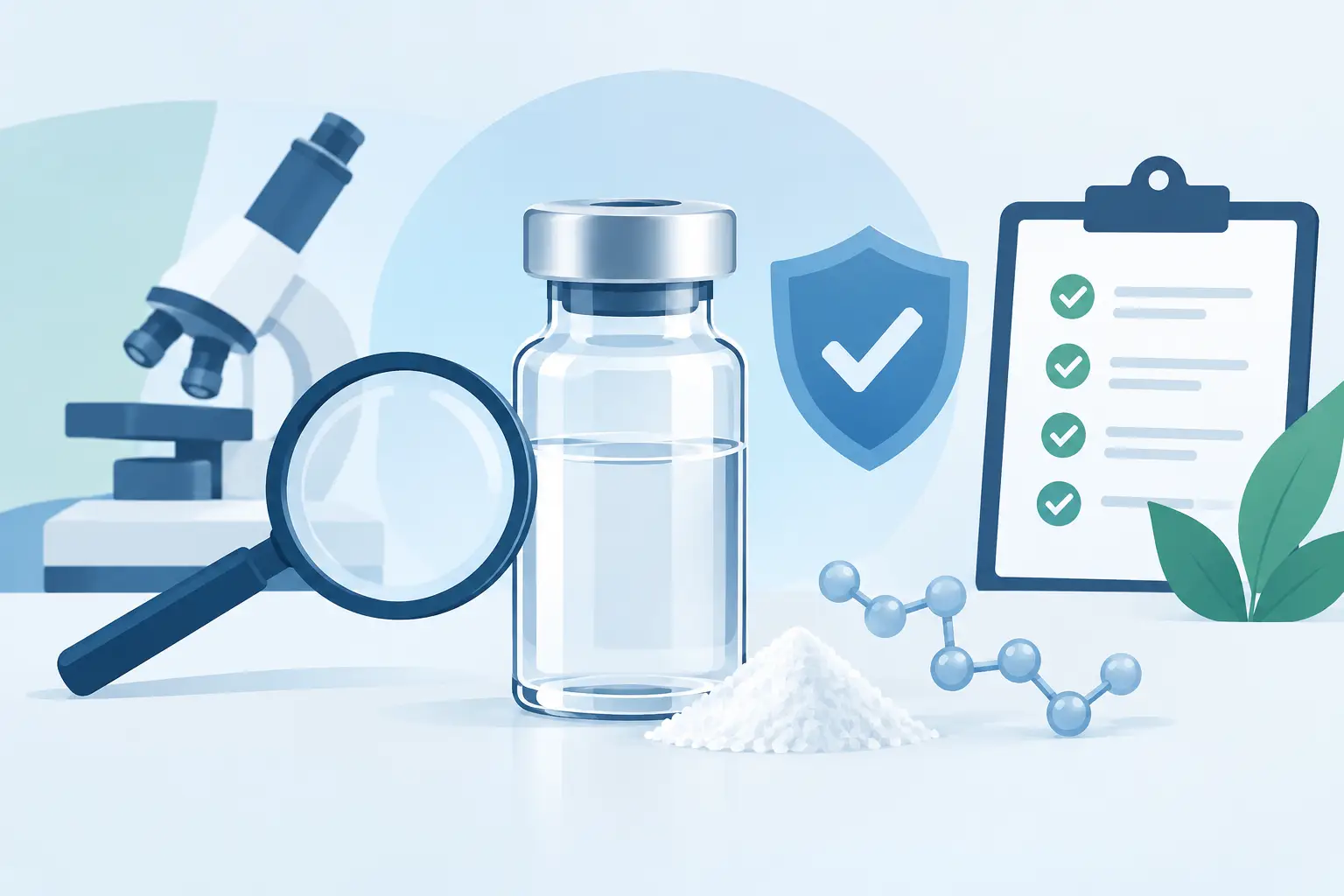
Start with a certificate of analysis, commonly called a COA. A meaningful COA should identify the product and lot or batch number, state the reported purity, and show relevant analytical results. For peptides, high-performance liquid chromatography, or HPLC, is commonly used to evaluate purity profiles. Mass spectrometry can support molecular identity by confirming expected mass. Depending on the material and use case, additional testing may be relevant.
A COA is not magic paperwork. Researchers should look at whether its lot number matches the product packaging and whether the report contains enough information to be useful. A generic, undated document with no batch connection is a weaker trust signal than a lot-specific report with clear test results and identifiable specifications.
Packaging and fulfillment also matter. Legitimate sourcing includes tamper-conscious packaging, readable labeling, lot identification, appropriate storage guidance, and a process that reduces the risk of mix-ups or preventable degradation. A peptide can test well when released yet become a poor research input if it is mislabeled, improperly stored, or handled carelessly afterward.
For a supplier operating in the research space, clear research-use-only boundaries are another credibility marker. Those boundaries are not a drawback or fine-print inconvenience. They show that the supplier understands the category and is not making unsupported claims about diagnosis, treatment, prevention, or human consumption.
The Difference Between High Purity and Pharmaceutical Status
High purity is valuable, but it does not equal pharmaceutical status.
A peptide advertised at 99% purity may be suitable for certain research applications, but the number alone does not answer every quality question. Purity can refer to the percentage of the target analyte relative to detected impurities under a stated method. It does not automatically establish sterility, endotoxin limits, residual solvent profile, biological activity, formulation suitability, stability under every condition, or fitness for a particular protocol.
That does not make high-purity research material illegitimate. It simply means researchers should align the evidence to the study. An analytical workflow may prioritize identity confirmation and chromatographic purity. A sensitive cell-based study may require additional consideration of contaminants, storage history, preparation procedures, and experimental controls.
Likewise, a supplier can accurately position a product as lab-tested and research-grade while avoiding the claim that it is pharmaceutical grade. That language is often more precise for materials intended exclusively for laboratory research. Precision is a strength. It tells buyers what they are getting, what documentation supports it, and where the product’s intended-use boundary begins and ends.
How to Vet a Peptide Supplier Before Ordering
The fastest way to spot weak sourcing is to look past the product name. Credible suppliers make it easier to find practical information about testing, packaging, support, and restrictions. Vague superlatives without supporting details should slow a purchasing decision down.
Before placing an order, qualified buyers should be able to answer these questions:
- Is there a lot-specific COA or clear process for obtaining one?
- Do the reported methods support the stated identity and purity claims?
- Does the package label connect the product to a batch or lot number?
- Are storage expectations and research-use-only restrictions clearly stated?
- Can the supplier provide responsive, professional support when documentation or order details need clarification?
No single item guarantees quality. A polished COA cannot compensate for poor packaging. Fast shipping cannot replace batch traceability. A strong assessment comes from the full chain: credible product information, relevant testing, controlled handling, accurate labeling, and transparent customer support.
It also helps to assess whether the supplier’s catalog and messaging match legitimate laboratory use. Product categories organized around research objectives can make sourcing more efficient, but the supplier should still be direct about restrictions. Marketing that promises personal outcomes, dosage advice, or consumption-related benefits is a major warning sign in a research-only category.
Red Flags Behind the “Pharma Grade” Label
Some warning signs are obvious. Others look polished until you ask for specifics.
Be cautious when a seller uses “pharma grade” as the only quality explanation, cannot connect a COA to the item being sold, or uses test reports that are difficult to read and impossible to verify. Be equally cautious when product pages make claims that belong to prescription-drug advertising while also calling the material research use only. Those messages conflict.
Another red flag is false certainty. Peptide quality is not established by a single percentage, influencer endorsement, or dramatic before-and-after claim. Responsible sourcing recognizes variables: the peptide sequence, the analytical method, the storage environment, the research model, and the controls built into the experiment.
Price deserves context, too. An unusually low price may reflect a legitimate inventory decision, but it can also signal shortcuts in testing, storage, labeling, or support. Higher pricing is not automatic proof of superior material, either. Documentation and consistency should lead the decision.
Build Purchasing Standards That Hold Up
For recurring peptide research, create a simple intake standard before the order arrives. Record the supplier, product name, lot number, reported purity, COA date, receipt date, storage condition, and any observations about packaging. This creates a practical trail when comparing results across lots or investigating an unexpected result.
It is also smart to separate sourcing confidence from experimental interpretation. A well-documented peptide lot supports better research, but it does not remove the need for appropriate controls, validated methods, and careful data analysis. Quality inputs improve the starting position. Good science still does the rest.
At Pepper Pep, the focus is high-purity, lab-tested research materials for qualified professionals, with clear research-use-only restrictions and product support built for serious laboratory workflows. That is the standard worth looking for: evidence that matches the claim, boundaries that match the category, and service that respects the work behind every order.
The best purchasing decision is rarely driven by the biggest label. Choose the supplier that gives your research team a clean trail to follow, then let disciplined methods carry the results forward.
All products and information provided on this website are intended for laboratory research purposes only. Products are not intended for human consumption and are not intended to diagnose, treat, cure, or prevent any disease.